
Foreign portfolio investors (FPIs) have withdrawn nearly Rs 5,109.21 crore from Indian government securities under the fully accessible route (FAR) in just three days, driven by global uncertainty, elevated crude prices, rising US Treasury yields, and a depreciating rupee.

From stuffed capsicums and comforting soups to salads, pasta and curries, here are some delicious ways to give this vegetable a starring role.

Two expatriate workers were killed after debris from a downed drone fell in an industrial area in the Sohar province of Oman.

The Middle East-India route is hotting up in December as several airlines are busy raising the number of flights.

28 Indian vessels carrying 778 seafarers are stranded in the Persian Gulf, prompting government monitoring and coordination to ensure their safety and security.

Saudi Arabia's East-West pipeline shutdown could make crude costlier for India as refiners face fewer supply routes and rising freight and insurance costs.

Moody's Ratings has sharply increased India's GDP growth forecast for fiscal 2026-27 to 7 per cent, making it the fastest among G20 economies, driven by economic resilience despite the Middle East conflict. However, the agency flagged significant inflation risks stemming from elevated oil prices and potential El Nino disruptions.

Indian benchmark indices, Sensex and Nifty, extended their rally in early trade, driven by strong buying in bank stocks, Reliance Industries, and positive global cues, despite foreign institutional investors offloading equities.

Ishan Kishan's unbeaten century put East Zone firmly in control as they ended Day 1 of the Duleep Trophy final on 385/4.

'It beggars belief that Saudi Arabia would deploy military force against India, a top partner and market.'

Indian stock markets, including the Sensex and Nifty, experienced a significant tumble in early trade, driven by escalating tensions in West Asia that pushed crude oil prices close to the USD 100-per-barrel mark, alongside selling in IT stocks and fresh foreign fund outflows.

Indian benchmark indices, Sensex and Nifty, experienced significant declines, with the Sensex falling 493 points and the Nifty dropping for the sixth consecutive day, primarily due to elevated crude oil prices reaching USD 91 per barrel and diminishing hopes for a diplomatic resolution in West Asia.

East Zone pacers Mohammed Shami and Mukesh Kumar chipped away at the wickets to leave South Zone tottering on 242/6 at stumps on Day 3, of the Duleep Trophy final.
Director Rahul Dholakia's film, which is based on the troubles in the Kashmir valley, will not be screened in Bahrain, Kuwait, Oman, Qatar and the United Arab Emirates.

Forty-nine-year-old Meloni has been Italy's prime minister since October 22, 2022.

Indian benchmark indices closed mixed, with the Sensex gaining 113.61 points to 78,079.96 and the Nifty falling 40.10 points to 24,395.85, as elevated crude prices and ongoing geopolitical uncertainty in the Middle East made investors cautious.
Indian benchmark indices closed mixed, with the Sensex gaining 113.61 points to 78,079.96 and the Nifty falling 40.10 points to 24,395.85, as elevated crude prices and ongoing geopolitical uncertainty in the Middle East made investors cautious.
NeoGeoInfo Technologies, a spatial intelligence solutions provider, has secured a Series A investment of approximately USD 20 million from Neev II Fund and Aavishkaar Capital. This funding will fuel the company's R&D, expand its international presence in the Middle East and Americas, and strengthen its team for complex projects.

Indian benchmark equity indices, Sensex and Nifty, opened higher on Monday, driven by strong buying in blue-chip stocks like HDFC Bank and Infosys, despite persistent geopolitical tensions and elevated crude oil prices.

Spain's Eugenio Chacarra won the DP World India Championship at the Delhi Golf Club by two shots, finishing 21-under 267. His victory, achieved despite a broken toe, showcased strategic course management and precise play. This win strengthens his bid for the Race to Dubai crown against top players like Patrick Reed and Rory McIlroy, marking another significant achievement in his career resurgence.

Indian benchmark indices, Sensex and Nifty, saw declines in early trade, influenced by rising crude oil prices and ongoing geopolitical tensions in West Asia. Experts suggest that crude oil remains a primary concern, with Brent holding near USD 88 a barrel due to renewed US warnings against Iran, embedding a geopolitical risk premium in energy markets. Track Sensex, Nifty

Six companies made their stock market debut on Thursday, setting a new record for the most mainboard listings on a single day since at least 1996.

Malaysia's Sepang circuit will host the rescheduled 'Gulf Air Bahrain Grand Prix in Malaysia' on October 4, Formula One announced, stepping in after the original April races in Bahrain and Saudi Arabia were cancelled due to the Iran war and Middle East situation.

India's foreign exchange reserves increased by $9.9 billion to $716.9 billion for the week ended August 14, as reported by the Reserve Bank of India (RBI). This surge follows a previous jump of $14.14 billion in the week prior, indicating a robust recovery after a period of decline earlier this year.

From the Sensex basket, Tata Motors, State Bank of India, Tata Steel, Power Grid, NTPC, Bajaj Finserv, Bajaj Finance and Asian Paints were the major laggards.

The plan, which was three years in the making, offers a path towards a two-state solution and presents a "contiguous" territory for a Palestinian state, the US president said.

The United States launched military action against two Iranian launch systems on Larak Island, prompting Iran to claim retaliation with ballistic missile launches targeting two US air bases in Jordan.

Analysts predict that the Indian stock market's sentiment this week will be primarily influenced by the domestic GDP data announcement, crude oil prices, and the crucial US non-farm payrolls report.
Indian benchmark equity indices, Sensex and Nifty, closed lower due to persistent geopolitical tensions in the Middle East and elevated crude oil prices, with investors remaining cautious ahead of fresh US sanctions on Iran.
Indian benchmark indices Sensex and Nifty saw a rebound in early trade, driven by a moderation in crude oil prices, despite persistent selling by Foreign Institutional Investors (FIIs) and mixed global market cues.

Golf star Rory McIlroy has voiced strong support for the DP World Tour's recent decisions concerning players involved with LIV Golf. He backed the Tour's move to restrict LIV players from its 2027 season and its right to protect business interests, while also highlighting the Tour's opportunity to showcase international golf during less crowded periods in the PGA Tour schedule. McIlroy, a DP World global ambassador, expressed his commitment to the Tour and shared his thoughts on returning to the Delhi Golf Club.
Indian benchmark equity indices, Sensex and Nifty, rebounded in early trade, driven by a recovery in world markets due to easing US Treasury yields and fresh foreign fund inflows, halting a multi-day losing streak. Track Sensex, Nifty on August 20.

Wipro reported a marginal 1.40 per cent decline in consolidated net profit to Rs 3,200.6 crore for the July-September quarter of FY27, despite a 9.1 per cent increase in revenue from operations to Rs 24,752.7 crore.

US President Donald Trump on Friday (local time) said the United States could "hit" Iran's heavily fortified underground nuclear site known as Pickaxe Mountain "very soon", days after Washington targeted Iranian military targets.
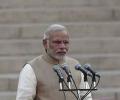
Pakistan and Israel will define the relationship between the Modi government and the Middle East. While the region is concerned that India-Pakistan relations may become prickly in the Modi regime, it is also worried that the BJP government will give greater weightage to its ties with Israel.

Jaishankar emphasised that the stability of the Middle East region was essential because about one crore Indian citizens live there and said, "a large part of our shipping passes through this region and also, oil comes from there."
A four-member Indian golf team, comprising Harjai Milkha Singh, Ishnidh Singh Virdi, Guntas Kaur Sandhu, and Rashi Mishra, is set to compete in the prestigious R&A Amateur golf championship across two courses in Scotland. The tournament features both boys' and girls' categories, attracting top junior talent globally, with winners earning significant exemptions into major championships.

'India is a large source of Spotify's future audience growth because it is the largest market in the world.'
